Strategy
How to Write a Capability Statement That Wins Tier-1 and Government RFQs
 Kalk Solutions Editorial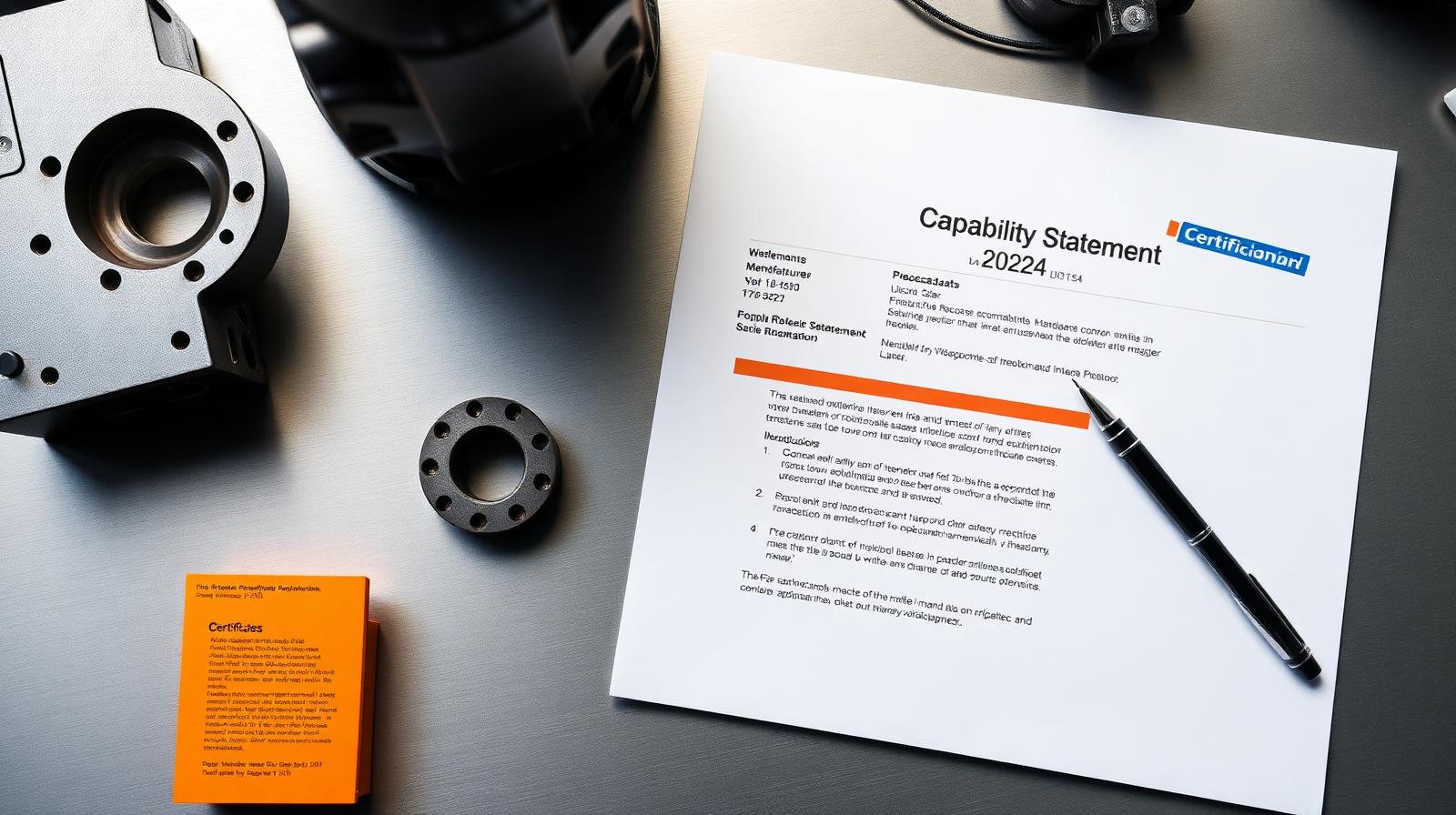
TL;DR
A winning capability statement is one page, scannable in 30 seconds, and answers seven questions: who you are, what you make, who buys from you, what proves it, your differentiators, NAICS and certs, and how to contact you. Procurement reads about 200 of these a week. The ones with vague claims, dense paragraphs, or no past performance get skipped in 5 seconds.
Quick answers
- What is a capability statement?
- A 1-page document a procurement manager uses to decide whether to invite you to bid. It summarises your company, capabilities, past performance, certifications, NAICS codes, and contact info in a scannable format.
- How long should a capability statement be?
- One page. Two at absolute maximum. Procurement teams skim, they do not read. Anything longer signals you cannot prioritise.
- What kills a capability statement instantly?
- Dense paragraphs, generic claims like 'world-class quality', no past performance with named clients, missing NAICS codes, and the contact info buried at the bottom.
If you sell to Tier-1 manufacturers, federal agencies, or state DOTs, the first thing procurement asks for is your capability statement. Not your website, not your brochure, not your deck. One page. The capability statements that win contracts share a specific structure most US manufacturers get wrong. Here is the template that works.
What is a capability statement and why does it matter?
Atomic answer: a capability statement is a 1-page sales asset procurement uses to decide whether to invite you to bid. It is read in 30 seconds. The structure - not the design - is what wins shortlist spots at Tier-1 OEMs and federal agencies.
The 7-section template that wins
| # | Section | What it contains |
|---|---|---|
| - | Header | Logo, company name, CAGE / DUNS |
| 1 | Company summary | 2 lines: who and where |
| 2 | Core competencies | 4 to 6 specific capabilities |
| 3 | Past performance | 3 named clients + dollar values |
| 4 | Differentiators | 3 specific claims, not "quality" |
| 5 | Certifications | ISO, AS, ITAR, NIST with cert numbers |
| 6 | NAICS / PSC codes | Primary + secondary |
| 7 | Contact block | Name, email, direct phone, URL |
1. Company summary (2 lines, no more)
"Precision CNC and Swiss-turning shop in Cleveland, Ohio. AS9100 and ISO 13485 certified, supplying medical, aerospace and defence OEMs since 1987."
That is it. Cut every adjective.
2. Core competencies (4 to 6 specific items)
Not "machining". Try "5-axis machining (titanium, Inconel, PEEK)", "Swiss turning under 1 mm diameter", "EDM (wire and sinker)", "ITAR-controlled assembly".
3. Past performance (the section that wins)
Three lines. Each line: client name, part type, contract value, year.
Lockheed Martin - precision-machined sensor housings - $1.4M - 2024 Stryker - Class III medical implant components - $2.1M - 2023 to 2025 US Navy via SeaPort-NxG - mission-critical valve assemblies - $640K - 2024
If you cannot name clients due to NDA, name the tier and contract type. "Tier 1 aerospace prime" is acceptable. "Major customer" is not.
4. Differentiators (3 specific, falsifiable claims)
Wrong: "World-class quality, on-time delivery, customer focus."
Right: "Average lead time 11 days from PO. 99.4% on-time delivery last 24 months. Sub-5-micron tolerances verified on Zeiss CMM."
5. Certifications (with cert numbers)
| Certification | Cert # | Expires |
|---|---|---|
| AS9100D | 12345 | Mar 2027 |
| ISO 13485 | 67890 | Aug 2026 |
| ITAR registered | M12345 | Annual |
| NIST 800-171 | Self-attested | 2025 |
6. NAICS and PSC codes
Primary + 4 to 6 secondary. Federal procurement filters on these.
| Code | Description | Notes |
|---|---|---|
| NAICS 332710 | Machine Shops | Primary |
| NAICS 332721 | Precision Turned Products | Secondary |
| NAICS 336412 | Aircraft Engine Parts | Secondary |
| PSC 1680 | Misc Aircraft Components | Secondary |
7. Contact block
Name, title, direct phone, direct email, website URL. Not "info@". Not "(800)". A human a procurement manager can call.
Reality check: A $6M Texas precision shop we worked with rewrote a 4-page capability statement into the 7-section, 1-page format above. They got onto three new Tier-1 approved-vendor lists in 90 days. The product was the same. The format was the unlock.
What kills a capability statement in 5 seconds
- Walls of text without bullets
- "World-class", "innovative", "cutting-edge" with no proof
- No past performance, no client names, no dollar values
- Contact info at the bottom of page 2
- Missing CAGE / DUNS / NAICS / PSC codes
- PDF over 2 MB or 3+ pages
How to measure if it is working
- Tier-1 approved-vendor list additions per quarter
- Inbound RFQs that reference your capability statement
- Time from first outbound to shortlist
- Government contract awards per year
Common mistakes
- One generic statement for every buyer, instead of sector-specific versions.
- Buried on a downloads page instead of linked from the homepage.
- Updated once and forgotten. Update every 6 months.
- No schema markup on the equivalent HTML page (lost AEO opportunity).
- Sending the brochure instead. Procurement will throw it out.
What to do next
Audit your current capability statement against the 7-section template above. If it misses 2+ sections, rewrite it this week. Book a free 30-minute audit and we will critique yours live on the call and send you a customised template.
Related reading: How to get more RFQs and Manufacturing marketing agency guide.
60-second live scan
See where your buyers are searching - right now.
Run your buyer-intent keywords through live Google. Get a competitor map and ranking gaps in 60 seconds. Free, no pitch.
Run my free Buyer Reach AuditPrefer a working session?
Book a 30-min call with our team.
No pitch. Walk away with a written action plan - whether you hire us or not.
Book a strategy callFor US manufacturers
Tired of ThomasNet junk leads?
Run a free 60-second audit of where your buyers are searching in the US. Get a real diagnosis — no pitch.
Questions about this topic
Do I need a capability statement to sell to the federal government?
Yes. SAM.gov registration plus a strong capability statement is the entry ticket for government contracting. Most contracting officers will not consider a vendor without one.
Should I have different versions for different sectors?
Yes. One for aerospace primes, one for medical OEMs, one for government and DoD. Each version emphasises the certifications, past performance, and part types relevant to that buyer.
Where do I publish the capability statement?
PDF on your website (linked from homepage and capability pages), in SAM.gov, in your DSBS profile, on LinkedIn company page, and attached to every outbound to procurement.
How often should I update it?
Every 6 months minimum, or whenever you add a major certification, customer, or capability. Stale capability statements signal a stale business.
Do AI search engines see capability statements?
Yes if they are HTML pages with structured data, not just PDFs. Publish the same content as a webpage with Organization and Service schema. Read our [AEO guide](/blog/ai-search-optimization-manufacturers).
Related field guides