Growth
How OEM Buyers Actually Find a New US Supplier: What Happens Before They Send an RFQ
 Kalk Solutions Editorial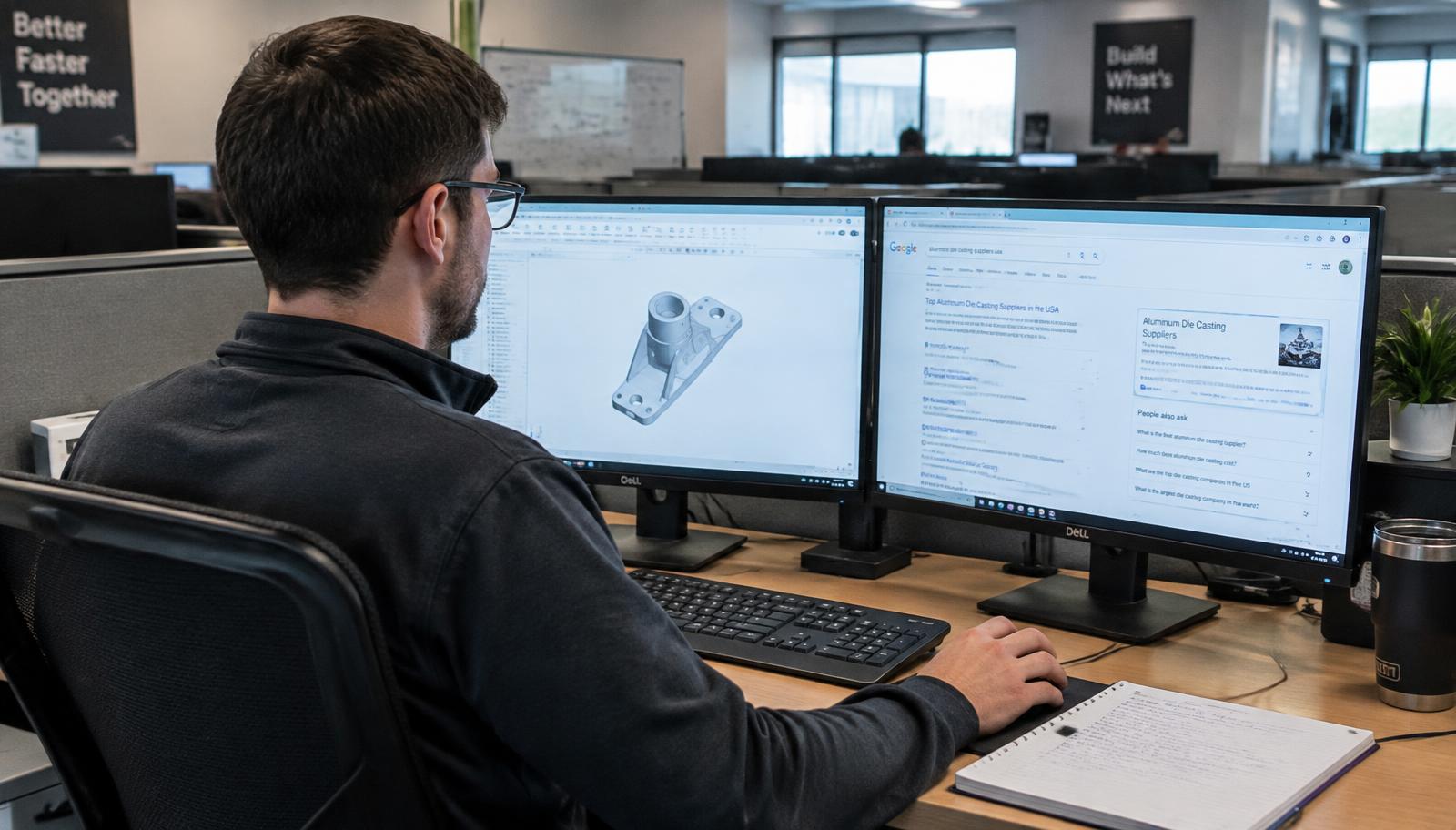
TL;DR
Most of an OEM's supplier decision happens before you ever see an RFQ. Engineers and buyers search, compare websites, check certifications, ask AI assistants and colleagues, then shortlist three to five suppliers. If your website does not answer their questions during that quiet phase, you never get the RFQ. Win the research phase and the RFQ follows.
Quick answers
- How do OEMs find suppliers?
- Through Google and AI search on part type, process and location; industry directories like ThomasNet; LinkedIn; trade shows; and referrals from colleagues. They then review supplier websites to build a shortlist before sending RFQs.
- What do OEM buyers check before sending an RFQ?
- Process capability, materials, tolerances, equipment, certifications, industries served, location, lead-time signals, and whether the website looks current and credible.
- How many suppliers get an RFQ?
- Typically three to five. Suppliers who are not on the initial shortlist rarely get a chance to quote.
Most US manufacturers think the sales process starts when an RFQ lands. For the OEM, it is almost over by then. The decision about who gets to quote is made in a quiet research phase you never see.
The five stages before an RFQ
Atomic answer: OEMs find suppliers by defining the need, searching, screening websites, validating credibility, and shortlisting. The RFQ goes only to the shortlist.
| Stage | What the buyer does | What they need from you |
|---|---|---|
| 1. Define | Engineer specifies part, material, tolerance, volume | Nothing yet |
| 2. Search | Google, AI assistant, ThomasNet, LinkedIn, colleagues | To appear for part type plus process plus location |
| 3. Screen | 30 to 90 seconds per website | Clear capability match above the fold |
| 4. Validate | Certifications, equipment, industries, examples | Specific proof on capability pages |
| 5. Shortlist | Pick three to five to quote | An easy RFQ path |
Stage 2: what they type
Real searches look like:
- "5-axis CNC machining titanium aerospace Ohio"
- "AS9100 sheet metal fabrication near Houston"
- "medical device Swiss turning supplier USA"
- "Which US machine shops can hold plus or minus 0.0005 in Inconel?" (asked to ChatGPT or Perplexity)
Notice the pattern: process + material + industry + location. Your pages need that same language. Our industrial SEO guide for buyer intent covers keyword structure.
Stage 3: the 60-second screen
When a buyer opens your site, they decide fast. They are scanning for:
- Do you do the process they need?
- Do you work in their material and tolerance range?
- Do you serve their industry?
- Does the site look like an active, modern operation?
A homepage that says "Your trusted partner for quality solutions" fails this screen. A homepage that says "CNC machining and assemblies for aerospace and defense. AS9100. 5-axis. Dayton, Ohio." passes.
Stage 4: validation
Buyers who pass the screen dig into capability pages. They want equipment lists, work envelopes, inspection equipment (CMM, optical), certifications with scope, and example parts. See what to show on capability pages for CNC, stamping and fabrication.
They also check for warning signs: a copyright year from 2019, broken links, stock photos, no physical address.
Stage 5: the shortlist
The suppliers who get the RFQ make it easy: a visible "Request a Quote" button, drawing upload, and a promise of a fast reply. For what buyers do after the RFQ, read how OEM buyers evaluate a new US supplier.
How to win the research phase
- Rewrite your homepage headline to name process, industry and location.
- Build one capability page per core process.
- Put certifications on the pages where buyers look.
- Make your site quotable by AI assistants with clear facts and FAQs.
- Reduce your RFQ form to the essentials.
Next step
See exactly what OEM buyers see when they search for your part types. Run the free Buyer Reach Audit, or learn how we build this for US shops on our USA page.
60-second live scan
See where your buyers are searching - right now.
Run your buyer-intent keywords through live Google. Get a competitor map and ranking gaps in 60 seconds. Free, no pitch.
Run my free Buyer Reach AuditPrefer a working session?
Book a 30-min call with our team.
No pitch. Walk away with a written action plan - whether you hire us or not.
Book a strategy callFor US manufacturers
Tired of ThomasNet junk leads?
Run a free 60-second audit of where your buyers are searching in the US. Get a real diagnosis — no pitch.
Questions about this topic
Do OEMs still use ThomasNet?
Some do, especially for initial discovery, but many now start on Google or an AI assistant and use directories to cross-check. See our ThomasNet alternatives guide for details.
Who is involved in choosing a new supplier?
Usually a sourcing or commodity manager, a design or manufacturing engineer, and a quality engineer. Each looks for different proof.
How long does the research phase last?
From a few days for urgent parts to several months for strategic programs. The shortlist is usually set early.
Related field guides