Strategy
How a Documented Sales Pipeline Increases What Your Manufacturing Business Sells For
 Kalk Solutions Editorial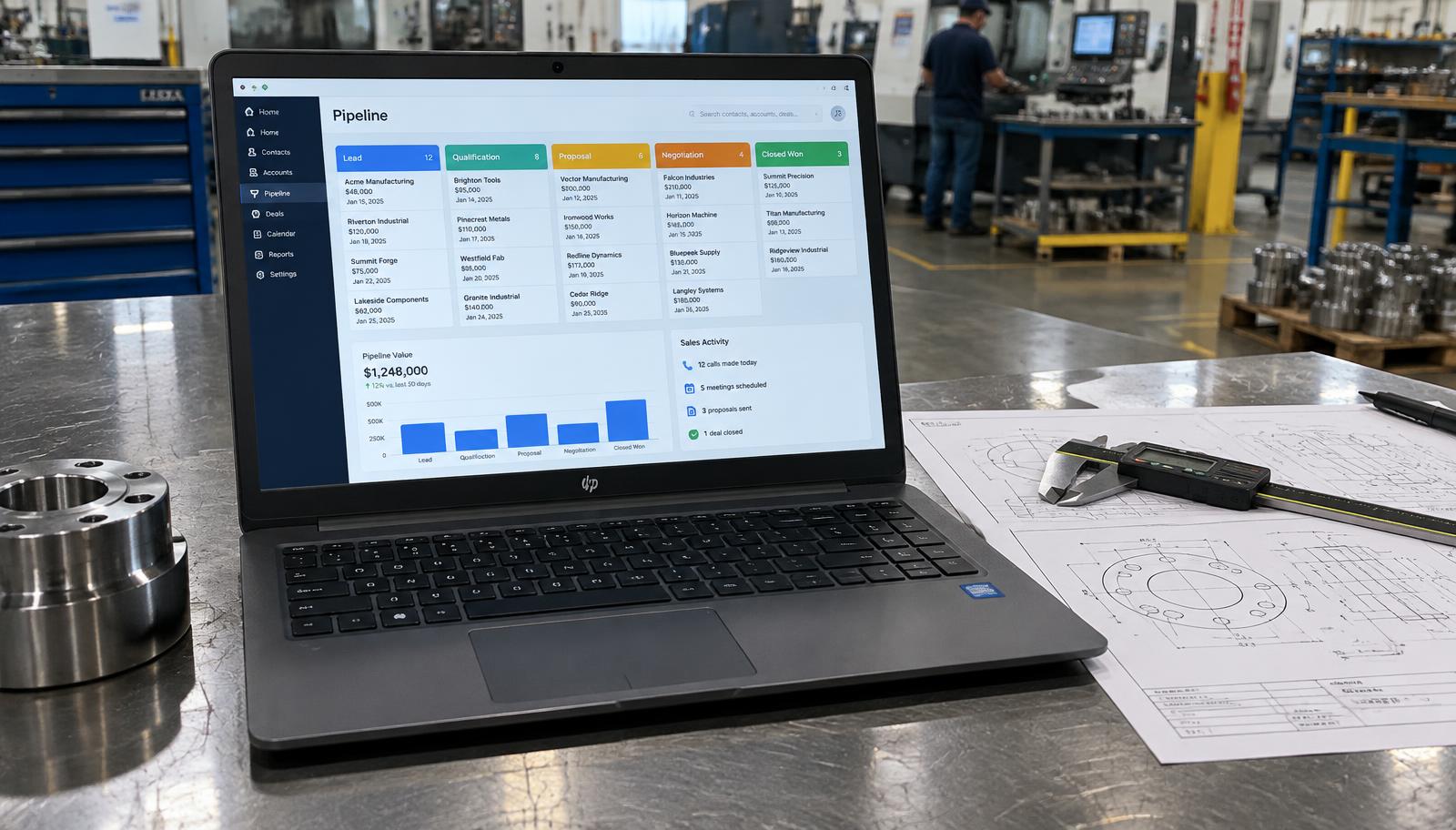
TL;DR
Buyers pay for future earnings they can trust. A documented sales pipeline (every opportunity, its stage, value, source and history, in a CRM) proves that new business comes from a company system, not the owner's memory. That reduces perceived risk, supports a better multiple, can reduce reliance on earn-outs, and speeds up due diligence. Start at least 2 to 3 years before a sale so the history is credible.
Quick answers
- Does a sales pipeline affect business valuation?
- It can. A documented pipeline with history reduces the buyer's uncertainty about future revenue, which supports a stronger multiple and better terms. It does not replace earnings; it makes them more believable.
- What should a documented pipeline include?
- Every opportunity with source, customer, value, stage, dates, owner and outcome, plus win rates and conversion times over at least 12 to 24 months.
- How far back do buyers want pipeline data?
- Two to three years of consistent records is persuasive. A pipeline created right before a sale looks like window dressing.
When a buyer reviews your manufacturing business, they are really asking one question: "How sure am I that this revenue continues and grows after the owner leaves?" A documented sales pipeline is one of the clearest answers you can give.
This article is general information. Work with your M&A advisor on valuation specifics.
Why buyers care about the pipeline
Atomic answer: the pipeline is evidence of future revenue and of a repeatable way to win customers. Evidence reduces risk, and lower risk supports better value and terms.
Without it, a buyer sees:
- Revenue from a few long-term customers
- New business that "just comes in"
- An owner who personally knows every buyer
That looks fragile. Buyers respond with lower multiples, earn-outs or long transitions. See what private equity buyers look at beyond EBITDA.
What "documented" actually means
| Element | What to record |
|---|---|
| Source | Website, search, referral, rep, trade show, existing customer |
| Customer and contact | Company, buyer, industry |
| Value and margin | Quoted value, expected margin |
| Stage and dates | Lead, qualified, quoted, follow-up, won/lost, with timestamps |
| Owner | Who in your company manages it |
| Outcome and reason | Won, lost, why |
The metrics buyers find persuasive
- New customers won per year, with trend
- Share of revenue from customers acquired in the last 3 years
- Quote win rate by industry
- Average RFQ-to-quote time
- Pipeline coverage for the next 6 to 12 months
- Share of opportunities sourced without the owner
How the pipeline changes the conversation
| Buyer concern | Without pipeline | With documented pipeline |
|---|---|---|
| Will customers stay? | Unknown | Retention and expansion history shown |
| Can the business grow? | "We think so" | Trend of new accounts and sources |
| Is it owner-dependent? | Likely | Opportunities owned by team members |
| How long is diligence? | Longer, more questions | Faster, data available |
How to build it (and make it credible)
- Start now. Two to three years of history matters.
- Use a CRM, ideally connected to your ERP, so quotes link to jobs. See ERP for small manufacturers.
- Follow a simple stage model. Our job shop pipeline guide uses five stages.
- Add inbound sources so the pipeline is not only the owner's contacts. See why word-of-mouth won't get you to $25M.
- Review monthly and keep definitions consistent.
For exit planners and business brokers
Share this with clients who are 2 to 5 years from a sale. If you want to collaborate on preparing manufacturing clients, see our partner program.
Next step
Fill your pipeline with buyers who find you, not just people you know. Run the free Buyer Reach Audit.
Related: Selling your manufacturing business in 3 to 5 years? The systems to fix first.
60-second live scan
See where your buyers are searching - right now.
Run your buyer-intent keywords through live Google. Get a competitor map and ranking gaps in 60 seconds. Free, no pitch.
Run my free Buyer Reach AuditPrefer a working session?
Book a 30-min call with our team.
No pitch. Walk away with a written action plan - whether you hire us or not.
Book a strategy callFor US manufacturers
Tired of ThomasNet junk leads?
Run a free 60-second audit of where your buyers are searching in the US. Get a real diagnosis — no pitch.
Questions about this topic
Is a spreadsheet good enough?
It is better than nothing, but a CRM with timestamps and history is far more credible in due diligence.
Who should share this with my advisor?
Your M&A advisor or exit planner will use pipeline data in the information memorandum. Give them clean exports and definitions.
What if my pipeline shows low new-customer activity?
Better to know now. Use it as a baseline and build inbound demand before going to market.
Related field guides