Growth
How to Build a Sales Pipeline for a Job Shop When the Owner Is the Only Salesperson
 Kalk Solutions Editorial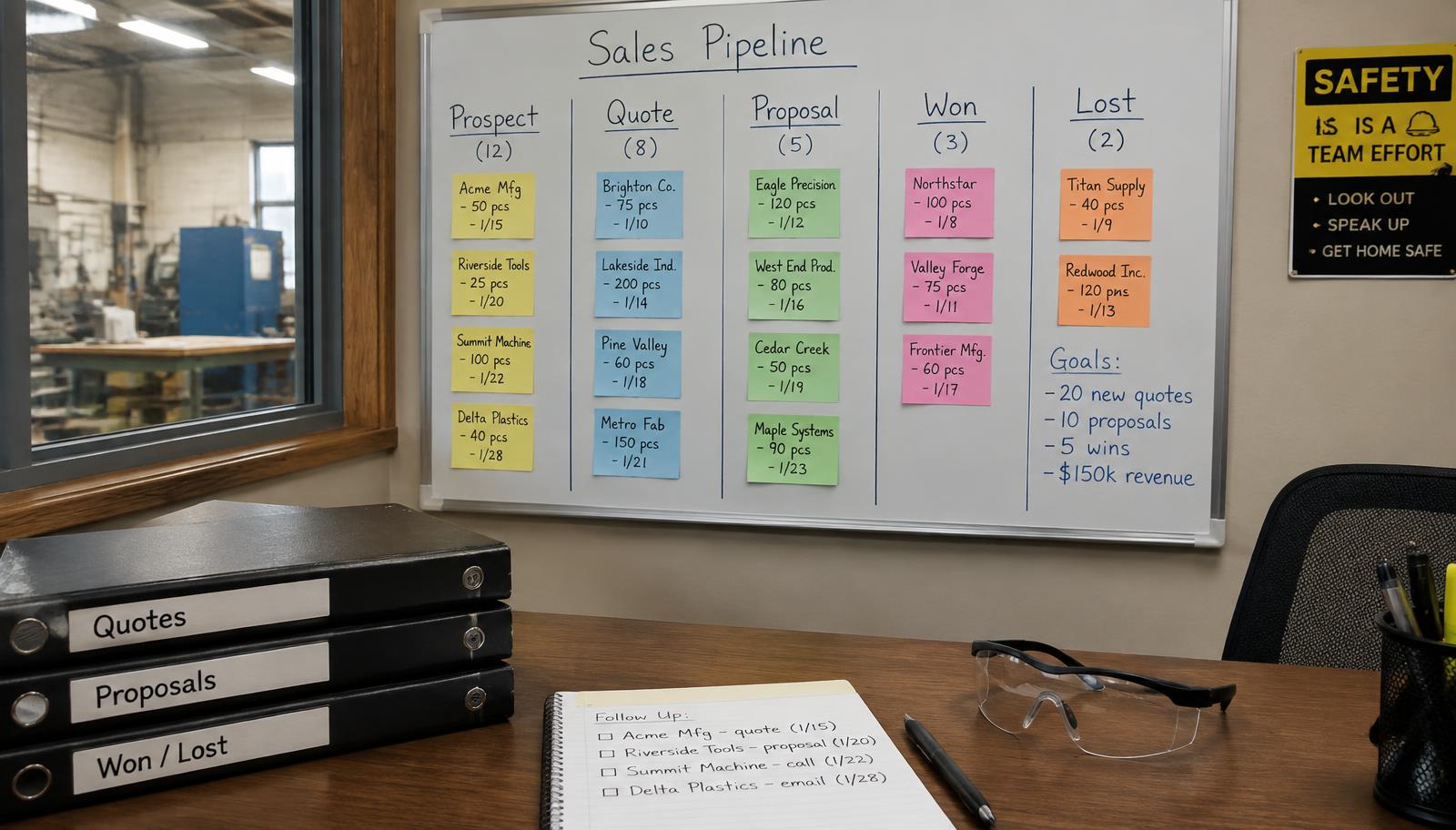
TL;DR
A job shop pipeline does not need a sales team. It needs five clear stages (Lead, Qualified, Quoted, Follow-up, Won or Lost), one place to track them, a steady inbound source, and a weekly 60-minute review. The owner can run it in about three hours a week, and it becomes the foundation for hiring sales help and for a higher exit value later.
Quick answers
- What is a sales pipeline for a job shop?
- A tracked list of every potential job from first contact to won or lost, with its stage, value, probability and next step. It shows what work is coming and where deals are stuck.
- What stages should a job shop pipeline have?
- Five is enough: Lead, Qualified, Quoted, Follow-up, and Won or Lost. More stages usually mean less discipline.
- What tool should a small job shop use?
- Start with a simple CRM or the CRM module in your ERP (Odoo, HubSpot free, Pipedrive). A spreadsheet works for the first month, but it breaks once more than one person uses it.
When the owner is the only salesperson, sales happens in gaps: between a machine breakdown, a hiring problem and a late shipment. Quotes go out. Some get followed up. Most do not. A pipeline turns those gaps into a system.
The 5-stage job shop pipeline
Atomic answer: track every opportunity through five stages (Lead, Qualified, Quoted, Follow-up, Won or Lost), with a value and next step for each, and review it weekly.
| Stage | Definition | Exit rule |
|---|---|---|
| Lead | Someone showed interest (RFQ, call, form) | Qualified or discarded within 2 days |
| Qualified | Right part type, volume, timing and buyer | Quote sent |
| Quoted | Quote delivered | Follow-up scheduled |
| Follow-up | Active conversation on the quote | Won, lost or parked |
| Won / Lost | Decision recorded with reason | Review monthly |
Step 1: pick one place to track it
A whiteboard works for a week. A spreadsheet for a month. After that, use a CRM. If you run or plan to run an ERP, use its CRM so quotes connect to production. See ERP for small manufacturers: Odoo vs spreadsheets vs legacy systems.
Step 2: fill the top of the pipeline
A pipeline without inbound leads is just a list of old customers. You need sources that do not depend on your phone:
- Website and search: capability pages that rank. See capability pages that win RFQs.
- Existing customers: ask every quarter what else they are sourcing.
- Reshoring and re-sourcing buyers: see how small machine shops win reshoring work.
- LinkedIn: short owner posts on capacity and recent work.
Step 3: qualify fast
Five questions for every lead:
- Is this a part type we are good at?
- Is the volume and timing realistic for us?
- Is this the decision-maker or an influencer?
- Is there a real program, or just price checking?
- Would we want this customer in three years?
Step 4: follow up on a schedule
Most lost quotes are not lost on price. They are lost to silence. Use day 3, day 10, day 21. Our sales SLA guide explains response times in more detail.
Step 5: the weekly 60-minute review
Every Monday:
- New leads this week
- Quotes sent
- Quotes needing follow-up
- Won and lost, with reasons
- Pipeline value for the next 90 days
Numbers to track
| Metric | Why it matters |
|---|---|
| New qualified leads per month | Shows whether demand is growing |
| Quote win rate | Shows fit and pricing |
| Average days from RFQ to quote | Speed wins jobs |
| Pipeline value (90 days) | Predicts your schedule |
| Share of revenue from new customers | Tracks concentration risk |
Why this matters for your exit
A documented pipeline proves future revenue does not live only in your head. Read how a documented sales pipeline increases what your business sells for.
Next step
Fill the top of your pipeline with buyers who are already searching. Run the free Buyer Reach Audit or see our USA growth system.
60-second live scan
See where your buyers are searching - right now.
Run your buyer-intent keywords through live Google. Get a competitor map and ranking gaps in 60 seconds. Free, no pitch.
Run my free Buyer Reach AuditPrefer a working session?
Book a 30-min call with our team.
No pitch. Walk away with a written action plan - whether you hire us or not.
Book a strategy callFor US manufacturers
Tired of ThomasNet junk leads?
Run a free 60-second audit of where your buyers are searching in the US. Get a real diagnosis — no pitch.
Questions about this topic
How many quotes should a job shop send each month?
It depends on job size, but many $5M to $20M shops need 20 to 60 quotes a month to win steady new work at a 20 to 35% win rate.
How often should I follow up on a quote?
Day 3, day 10 and day 21 after sending is a simple rule. Most shops follow up once or not at all.
When should I hire a salesperson?
When inbound RFQs are steady and the pipeline is documented. A new hire with no pipeline and no inbound demand usually struggles.
Related field guides